If you've lived in Ocoee for more than one summer, you already know what it means to depend on your air conditioner. From the July heat pressing down on West Orange County to the near-daily afternoon thunderstorms that send humidity soaring, your HVAC system works harder here than almost anywhere else in the country. The problem is, most homeowners don't notice anything is wrong until the system stops cooling altogether — and by then, a simple maintenance fix has often turned into an expensive repair.
Ocoee's subtropical climate creates a specific kind of stress on residential HVAC equipment. Year-round operation, high moisture loads, and heavy oak and pine pollen from nearby West Orange Trail corridors all accelerate wear in ways that generic maintenance checklists don't account for. Knowing the early warning signs — the ones specific to how systems behave here — can save you from a breakdown when temperatures peak above 95°F.
TL;DR Quick Answers
What Is HVAC Maintenance in Ocoee — and Why Does It Matter Here?
Ocoee's subtropical climate puts HVAC systems under year-round stress. High humidity, heavy seasonal pollen, and summer heat indexes above 100°F accelerate wear faster than in cooler, drier markets. Regular maintenance isn't optional here — it's what keeps systems running when it matters most.
What a tune-up includes:
Cleaning evaporator and condenser coils
Clearing condensate drain lines
Checking refrigerant levels
Inspecting electrical components
How often: Once per year minimum — ideally spring before peak cooling season. Biannual service is the smarter choice for older systems.
Top Takeaways
• Warm or uneven air is often the first sign of a developing problem — don't wait until the system stops working.
• Rising energy bills frequently indicate a loss of efficiency that maintenance can reverse.
• Ocoee's humidity makes musty odors and ice formation higher-risk symptoms than in drier climates.
• Short cycling is hard on compressors — catching the cause early prevents the most expensive failure.
• Annual preventive maintenance in Central Florida's climate isn't optional — it's what keeps systems running through peak summer heat.
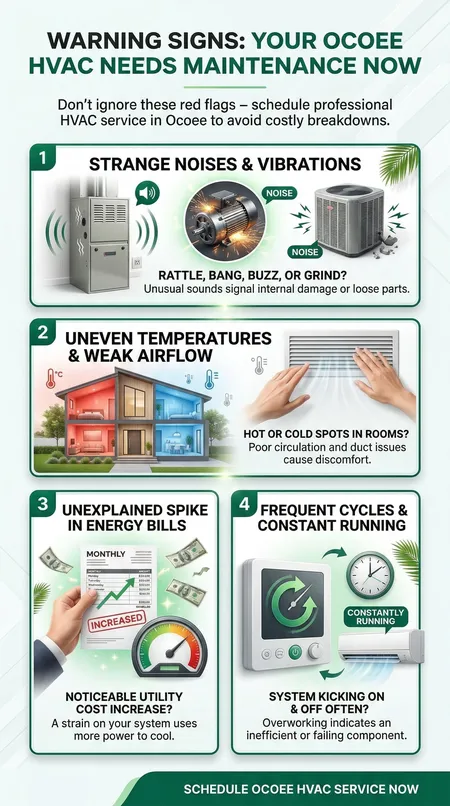
Warning Signs That Shouldn't Be Ignored
1. Your Home Isn't as Cool as It Should Be
In Ocoee's peak summer heat, your system should be able to maintain a consistent set temperature. If you're noticing warm spots, uneven cooling between rooms, or that the thermostat just never seems satisfied, your system is struggling. This is often caused by a dirty evaporator coil, low refrigerant, or restricted airflow — all preventable with routine maintenance.
2. Energy Bills Are Climbing
A well-maintained HVAC system runs efficiently. When components are dirty or worn, the system compensates by running longer cycles and consuming more energy. If your OUC or Duke Energy bill has climbed noticeably compared to the same month last year, your system's efficiency is dropping. Maintenance typically restores that lost efficiency.
3. Unusual Noises
A properly functioning system should be quiet in the background. Rattling could mean loose hardware or debris in the unit — not uncommon after Ocoee's storm season when yard debris finds its way into outdoor condenser units. Squealing often signals a worn blower belt or motor bearing. Grinding typically means the motor is failing. None of these sounds go away on their own.
4. High Indoor Humidity
Ocoee's average relative humidity runs 70–80% through most of the year. Your AC system does double duty — it cools the air and removes moisture. If the air inside feels muggy or clammy even when the system is running, the unit may be undersized, low on refrigerant, or the evaporator coil may be iced over. Persistent high indoor humidity also creates conditions for mold growth in ductwork.
5. Short Cycling
Short cycling — when your system turns on, runs briefly, and shuts off before completing a full cooling cycle — puts excessive wear on the compressor. In Central Florida, this is often caused by a dirty air filter restricting airflow, an oversized system, or refrigerant issues. Left unaddressed, short cycling dramatically shortens system lifespan.
6. Ice on the System
Finding ice on the refrigerant lines or the indoor air handler is a clear signal something is wrong. This typically points to blocked airflow (check your filter first), a dirty coil, or low refrigerant charge. Ice formation means the system is not transferring heat properly, and running it this way risks compressor damage.
7. Musty or Burning Odors
A musty smell usually indicates microbial growth inside the air handler or ductwork — a real concern in Ocoee's humid environment. A burning smell may mean an electrical component is overheating. Either scenario warrants prompt professional attention.
"In Central Florida, we see systems fail prematurely because homeowners wait for total breakdowns rather than acting on early warnings. An HVAC system running in Ocoee is under continuous stress — the humidity alone causes wear that most people underestimate until it's too late."
Essential Resources
1. U.S. Department of Energy — Home Heating & Cooling
Covers HVAC efficiency standards, maintenance basics, and energy-saving tips for residential systems.
Source: https://www.energy.gov/energysaver/home-heating-and-cooling
2. EPA — Indoor Air Quality and HVAC
Authoritative resource on how HVAC maintenance directly impacts indoor air quality and household health.
Source: https://www.epa.gov/indoor-air-quality-iaq
3. ASHRAE — Residential HVAC Standards
Industry technical standards for residential HVAC design, maintenance intervals, and ventilation requirements.
Source: https://www.ashrae.org
4. Florida Department of Business and Professional Regulation — Contractor Licensing
Verify Florida HVAC contractor licenses and check complaint histories before hiring any technician.
Source: https://www.myfloridalicense.com
5. ACCA (Air Conditioning Contractors of America)
The leading trade organization for HVAC professionals, offering consumer guidance and contractor quality standards.
6. ENERGY STAR — Heating and Cooling
Federal program identifying high-efficiency HVAC equipment and providing guidance on system maintenance and upgrades.
Source: https://www.energystar.gov/products/heating_cooling
7. CDC — Mold and Indoor Air Quality
Covers the health impacts of mold growth in HVAC systems and ductwork — particularly relevant in Florida's humid climate.
Source: https://www.cdc.gov/niosh/topics/indoorenv/mold.html
Supporting Statistics
1. HVAC systems account for nearly half of residential energy use in the U.S., according to the U.S. Department of Energy. In Ocoee, where systems run year-round, that percentage trends even higher — making efficiency maintenance a direct financial issue, not just a comfort one.
Source: https://www.energy.gov/energysaver/home-cooling-systems
2. The EPA estimates that poor indoor air quality — often driven by unmaintained HVAC systems — costs the U.S. economy billions annually in lost productivity and healthcare costs. In humid markets like Central Florida, neglected air handlers and ductwork are a primary source of airborne contaminants.
Source: https://www.epa.gov/report-environment/indoor-air-quality
3. According to ENERGY STAR, a typical household spends more than $2,000 per year on energy, with heating and cooling representing the largest share. A well-maintained system running in Florida's climate can reduce that cost meaningfully compared to a neglected one.
Source: https://www.energystar.gov/campaign/home_energy_audits/understanding_your_home_energy_use
Final Thought & Opinion
HVAC maintenance in Ocoee isn't the same as HVAC maintenance anywhere else. The combination of near-constant system operation, relentless humidity, and seasonal pollen loads creates conditions that accelerate wear faster than in cooler, drier climates. A system that might last 15 years with annual tune-ups in a northern state may struggle to hit 10 years in West Orange County without the same attention.
The warning signs described in this article are worth taking seriously precisely because they show up before a breakdown — not after. Acting on them early keeps repair costs manageable, preserves system efficiency, and extends the lifespan of your equipment. The most expensive HVAC call is always the emergency one on a 97°F afternoon in August.
• Watch for multiple signs together — one symptom may be minor, but two or three appearing at once usually mean the system needs attention.
• Don't dismiss rising energy bills as just rate increases. Compare month-over-month against the same period last year before assuming the utility company is the problem.
• Florida's humidity makes mold risk inside HVAC systems real. If you're noticing musty odors, that's a health issue as much as a comfort one.
FAQ on "HVAC Maintenance in Ocoee"
Q1: How often should I schedule HVAC maintenance in Ocoee, FL?
A: At minimum, once per year — ideally in early spring before peak cooling season begins. Because systems run nearly year-round in Central Florida, many homeowners benefit from biannual service: once in spring and once in fall.
Q2: What does a standard HVAC maintenance visit include?
A: A thorough tune-up should cover:
• Cleaning evaporator and condenser coils
• Checking and topping refrigerant if needed
• Inspecting electrical connections and capacitors
• Lubricating moving parts
• Testing thermostat calibration
• Inspecting drain lines for clogs (critical in humid climates)
• Replacing or inspecting air filters
Q3: Why is my AC running constantly but not cooling the house?
A: Several causes are common in Ocoee:
• Dirty evaporator coil reducing heat transfer
• Low refrigerant charge
• Ductwork leaks losing conditioned air
• Air filter is blocked and restricting airflow
A maintenance visit can diagnose which issue is causing the problem.
Q4: Can I do any HVAC maintenance myself?
A: Yes — a few tasks are DIY-friendly:
• Replace or clean air filters every 30–60 days (more frequently near wooded areas with heavy pollen)
• Clear debris from around the outdoor condenser unit
• Pour a cup of diluted bleach monthly into the condensate drain line to prevent clogs
However, refrigerant checks, coil cleaning, and electrical inspections require a licensed technician.
Q5: How do I know if I should repair or replace my HVAC system?
A: Consider replacement if:
• The system is 12–15+ years old
• Repair costs exceed 50% of a new system's price
• The system uses R-22 refrigerant (phased out and expensive to service)
• Energy bills have increased steadily despite regular maintenance
If the system is under 10 years old and the repair is isolated, maintenance and repair usually make more financial sense.
Schedule Your HVAC Maintenance in Ocoee
If your system is showing any of the warning signs above, don't wait until the hottest week of summer to find out how serious it is. Scheduling preventive maintenance now is the most reliable way to protect your home's comfort and avoid costly emergency repairs.
Here is the nearest branch location serving the Ocoee area. . .
Filterbuy HVAC Solutions
2900 Titan Row # 128, Orlando, FL 32809
(407) 204-1859
https://maps.app.goo.gl/NL6cB91PWLscgQkaA